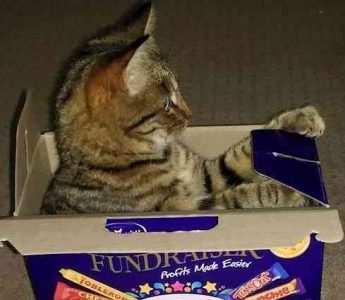

In light of the Netflix smash hit show ‘Tiger King’, I wanted to talk about the realities of caring for (because one should never own) wild animals, or animals which should be wild. I should admit to never having cared for a big cat of any kind, beyond the oversized lump of fur that is my older cat. While equalling the size of a husky toddler, she poses all the threat to my wellbeing of a salad leaf being added to my daily diet. Her presence is supposed to extend my longevity but eveything else I do kind of cancels it out. I wont comment about the practices of keeping tigers, lions, bobcats and bears (had to throw the panthers in there to avoid the ‘oh my!’ but then it felt silly to say nothing) in cages and without a lot of stimulation. I’ll stick to my views on the overarching principle of keeping wild animals.
When I was about eleven years old, my mother, searching for the kind of unconditional love that a child learns to withhold out of spite, started taking in animals she felt needed rescuing. Its up for debate whether they always genuinely needed rescuing or were in fact kidnapped, but my observational skills and gullibility were both still at the wrong end of their development, and so I saw my mum as some kind Florence Nightingale, for nightingales (except to be accurate, not actual nightingales, who are not indigenous to Australia, so she was more of a Florence Tawny Frogmouth).
It began with ‘saving’ newborn lambs she would ‘find’ ‘abandoned’ in a field opposite her workplace, which was, very ironically, a battery egg farm and hatchery. In an act of world class cognitive dissonance, she was responsible for ‘debeaking’ the day old chicks. This involved pressing their little beaks against a hot iron to blunt them and make pecking egg collectors and other chickens less of an issue. To balance out the hypocrisy there, mum eventually liberated several hens from the battery farm. She performed daily physiotherapy on them to get their legs working again when they progressed to leg strengthening exercises in baby bouncers which hung in a line from the roof of a shed in our backyard. Once fully recovered they were turned out for a lifetime of free range fossicking in our large yard.
Back to the lambs though; Spunky and Maisie were two that stick in my mind. Maisie was friendly, but much less easy going than Spunky, a ram who would happily trot along the road with us on a leash to the playground and didnt seem distressed when we would put him in the toddler swing (although I admit to not paying a lot of attention to his level of comfort in my 11 year old enthusiasm for novelty). Over the years our menagerie increased and mum’s obsession with caring for animals became something bigger. Sheep, goats, ducks and chickens made way for possums, koalas, kangaroos, wallabies, various birds of prey and the occasional reptile. It wasnt long before mum formalised her activities and became a registered wildlife shelter operator, and as with anything else she did, I was her assistant.
Our family home was full of animals. Any call-outs to the vet or the conservation department for animals orphaned or injured in the region were directed to my mum. The boot of the car constantly packed with the things we would need to retrieve and care for these creatures and day or night, when the calls came, we dropped everthing and went out. All sounds quite exciting and wholesome, doesnt it? Ha! Mum was not one for doing things with measured reason. She would often drag me out into the cold night for a rescue without first having checked that we had enough petrol to get us there or knowing we didnt have much, willing to take the chance. She also didnt really believe in maps, or any kind of formal (or informal, for that matter) navigation. If given directions, she would write them down and then invariably forget to bring them, or decide to try an alternate route on rural backroads she didnt know. Despite my fear of being stranded without petrol on the side of a dark rural road in the middle of the night, I found myself caught in the graviational pull of her passion and earnestness to be a saviour to these creatures.
Having wild animals in a family home could be a challenge though. It was more than once that the first sign of a possum having got out of its enclosure was the painful sensation of it crawling up my leg with its razor sharp claws. The shock causing me jump out of bed which only made the possum dig its claws in further to avoid falling to the floor. Wild animals also arent toilet trained. This fact was well demonstrated by Molly, a swamp wallaby joey that we collected on the way to a family holiday, has to share my bed because she needed body heat during the night . Also worth noting is that most wild animals in Australia can and will hurt you. Scratches, kicks and bites from adolescent joeys are par for the course when rearing them. They need to learn how to fight and will practice on you. Koalas are invariably in foul moods and often bite and claw and grunt. I never enjoyed looking after them and have a lifelong disdain for their kind.
Then there is the sorrow of losing anmals you are caring for. The birds were always a challenge because success rates of saving really little baby birds is low, but we raised our share of birds from tawny frogmouths to falcons. My favourite bird to care for was the magpie. Nothing beats a magpie for character and personality though and to this day their presence is a sheer joy to me. A thoroughly beautiful one we rescued that was a true albino only lived a few months, but was the most beautiful, playful and clever bird. Another magpie, Squeaky, was a family favourite, as evidenced by it getting an actual name rather than possie for the possums, duckie for the ducks, chicky for the…you get the picture.
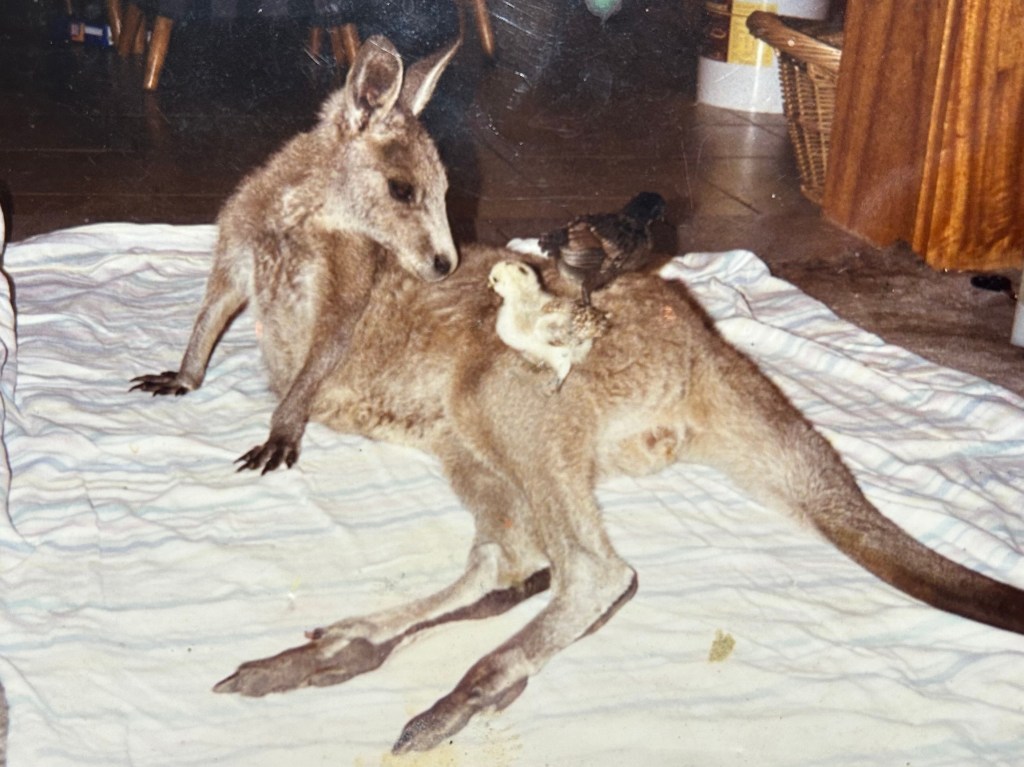
It was far from a nightmare growing up in a household with exposure to animals that many people will never get close to let alone be compelled to share a bed with. Kangaroos have strong personalities and it is really easy to tell them apart when you are rearing several at once. Princess, a girl joey who had very delicate features, would often nuzzle us and loved cuddles, Spikey our most boisterous joey enjoyed leaping on to my dad’s lap while he was watching tv and would lounge around with him for as long as he was allowed. Freddie loved playing with the chicks and baby animals that were around. The aforementioned wallaby Molly was very sweet. She loved cuddles and scratches and had the cutest little face. The various possums we cared for were always pretty cute (unlike amercian opossums which are sinfully ugly and do a real disservice to the species), and even the birds of prey could be pretty adorable. There were never any redeeming features in the koalas; they were just jerks.
Once reared into adulthood, it was really important to reduce our personal contact with the animals. A hard and fast rule of operating a wildlife shelter was that if you take in a wild animal and it cant be rehabilitated to be released back into the wild, it should be euthanised. So with that in mind, adolescence was when we would start to back off and adulthood was virtually no contact until release. Every animal that we had built a relationship with had to be able to feed itself and avoid humans. Most of the kangaroos went to a local wildlife reserve, possums usually went back to where they came from (although survival rates for possums released back into the wild is very low as possums are aggressively territorial) and birds of prey were also let go where they were found. One instance of a hawk with wing damage was different and a local zoo took him in. Occasionally we would visit the wildlife reserve where we released the kangaroos and call their names to no avail. While heartbreaking for my mother, that is how it is meant to be.
We all might want to have these creatures in our lives and within our reach, but we aren’t meant to. People who truly care about animal conservation understand this. My mum was all kinds of crazy when it came to animals. She would regularly patrol local roads hoping to come upon a native animal waving a tiny flare and writing SOS in the dirt, but she would never cross the line of having her need to care for them trump the needs of those beings to be what they are: wild. Dont get me wrong, I have no doubt the sheep were more likely abducted than abandoned. There is also an argument that when these animals became less dependent on her and more grown up, she needed a new fix of something more vulnerable to be suffocated with love, and so was happy to move on to the next orphaned wombat/koala/joey/yeti. It doesnt really matter why she did it (although she once yelled at us that she chose to care for animals because they couldnt talk back to her like we did), it matters that when she cared for wild animals, it was only ever with intention of returning them to the wild. No one should be allowed or ‘own’ exotic or wild animals. They are not ours to own. In fact I also refuse to say I own my cats or my dog. I have cats and a dog in my house that I care for. I dont own them. There is a quid pro quo going on there: I provide food and shelter and love and they get to let me. I still regularly marvel at the idea of one of my animals coming to me for the explicit purpose of being caressed by me. I can kind of understand why mum felt cuddling animals was better than cuddling us, although in fairness in dont recall her ever trying the latter for comparison.
 What is luck, anyway?
As usual, beautifully written, I think the best words I can think of are lyrical and poignant.
Thank you so much for your writing!
LikeLike
Lyrical and poignant, thank you so much for your writing!
LikeLike